
Solutions
John Harrison
November 2026
Introduction
First, we must understand our baseline: we are biological organisms heavily dependent on oxygen. The vast majority of the biosphere comprises plant life and photosynthetic marine organisms, which are entirely dependent on atmospheric carbon dioxide. To maintain homeostasis, there must be a balance, specifically, vast tracts of vegetation actively consuming CO2 and producing the oxygen required to sustain terrestrial animal life.
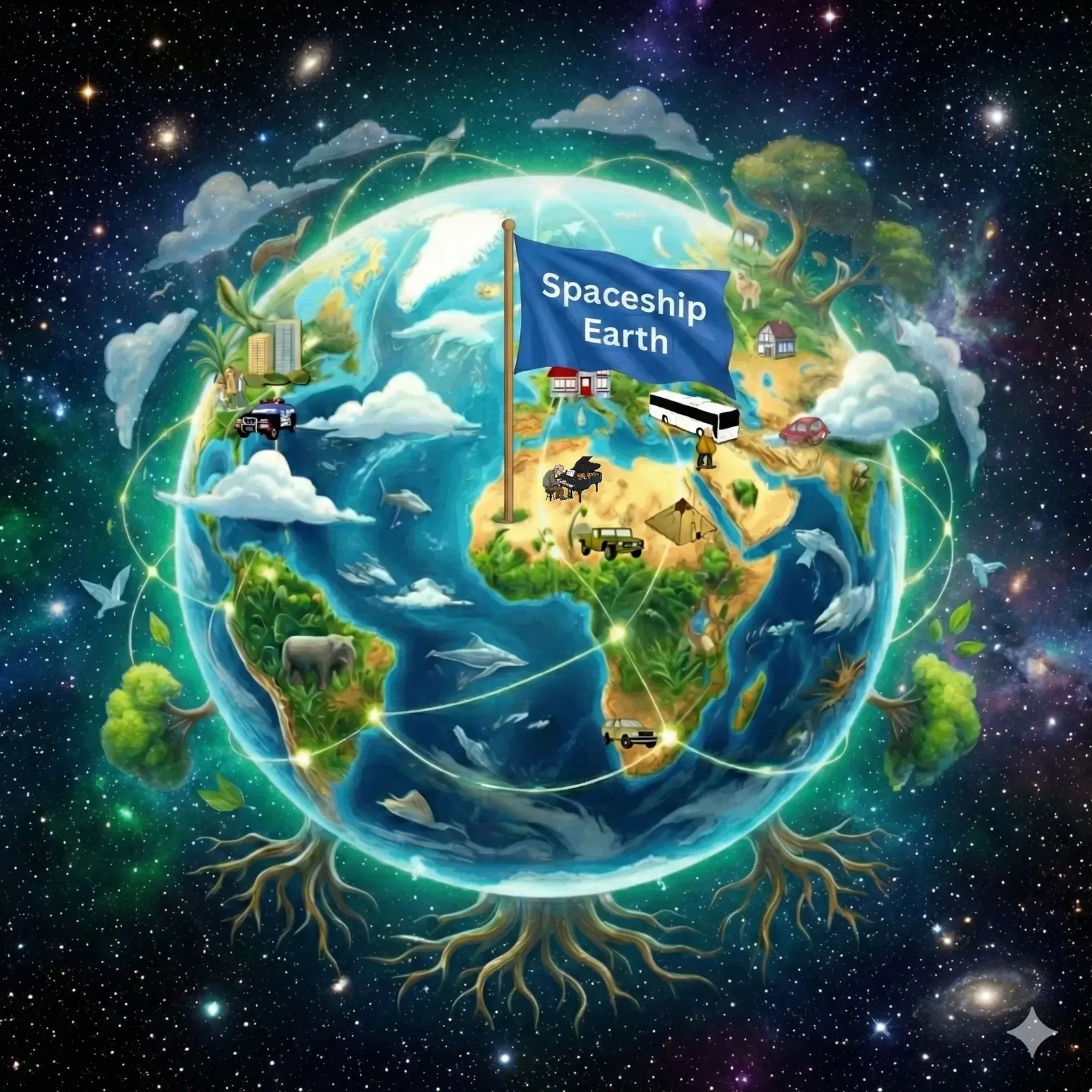
We live in a closed system analogous to a rather large closed terrarium or an operating spaceship (Boulding, 1966; Fuller, 1969), and have to understand the limitations.

I have detailed the scope of our planetary overshoot extensively, particularly in the “Directions” paper and the “Solutions” paper as well as other Gaia Engineering papers.
The historical records of past climate volatility, mass extinction events, and the concentrations of atmospheric oxygen, methane, and carbon dioxide provide an uncompromising baseline. While the feedback loops are complex, the fundamental equation is not: humanity is introducing mass and energy into the Eco-Sphere at a velocity that natural biogeochemistry cannot balance.
Fortunately, I was trained as an economist after crossing over from science. I was familiar with Keynesian supply and demand intervention, which helped me develop Moleconomic theory. The critical distinction is that in the natural world, supply does not spontaneously scale up to meet our industrial demand; in fact, under extraction pressure, the opposite may occur.
There have been mass extinction events in our geological past, but the current depletion rate of global biodiversity is anomalous (Almond et al., 2020). The numerical and graphical evidence of this collapse drove me, in my later years, to systematically engineer solutions rather than just diagnose the breakdown.
Decades ago, observing the correlation between rising atmospheric CO2 and oceanic heating, I invented TecEco cements. These Ca-Mg mineral binders can be blended with other mineral wastes such as fly ash and ground slags. Particle packing is deliberately gap-graded to maintain permeability in the formulations I called Eco-Cements atmospheric CO2 diffuses throughout the permeable matrix to complete the carbonation cure. The reactive magnesium oxide inputs are calcined at low-temperature preferably using renewable energy and CO2 capture during the process.
Rather than starting with energy-intensive calcium and magnesium ores, I realised that CO2-sparged desalination waste waters are an infinitely better source for low-temperature Ca & Mg carbonates. If deployed at scale, a built environment constructed from these carbonates would act as a permanent, gigaton scale geological sink for greenhouse gases. Unfortunately, much of that opportunity was stalled by the inertia of legacy industries and the friction of venture capital markets. However, the thermodynamic necessity of this technology has only grown more urgent. I am compelled to finalise this architectural framework to provide humanity with a physical way forward and hope industry has more common sense than to crush or ignore my efforts as before.
The Accountability Deficit and the Fragmentation of Power
The greatest damage caused by 20th-century neoliberalism may not have been the privatisation of public assets itself, but the catastrophic erosion of accountability. Responsibility for critical life-support services and civic infrastructure became hopelessly fragmented among disjointed governments, transient corporate boards, under-resourced regulators, and opaque contractors. As a result, decisions affecting millions of lives and vast tracts of the biosphere are made by corporates or institutions that are structurally insulated from public influence. A society cannot effectively govern its own survival when accountability is deliberately separated from power. This madness must stop.
The Strategic Pathway: Easy Fixes vs. Structural Realignment
To avoid public paralysis, we must sequence our interventions. We must urgently deploy the practical, immediate 'easy fixes' listed below, which require low capital and minimal political friction. Doing so will build momentum and demonstrate to an anxious global population that their leadership is capable of structural action. Once these initial interventions are active, we must systematically close the toxic, high-entropy waste chain by completely integrating the Technosphere into the Eco-Sphere.
Realignment of the Technosphere and Eco-Sphere requires strict adherence to two rules:
- Only return to nature what can be assimilated by nature: If a material must re-enter the environment (via wear, friction, or deliberate application), its molecules must be biologically benign and compatible with natural metabolic pathways.
- Give nature the physical room required to operate: Too much of the planet's surface has been appropriated for human agriculture and extraction. Gaia requires vast, contiguous tracts of undisturbed land to run global biogeochemical recycling engines. We must physically step back and relinquish territory to the Eco-Sphere.
Unfortunately, many individuals are trapped in immediate survival modes, whether economic precarity or active geopolitical conflict, leaving them no capacity to address planetary engineering. The responsibility for executing these solutions therefore falls entirely on governments, institutional capital, and the captains of industry.
While environmental advocates historically relied on moral persuasion, I operate on the reality that financial mechanics (profit, loss, and insolvency) are the ultimate drivers of industrial change. The core problem is moleconomic: we have the wrong molecules in the wrong places. We cannot simply ban pollution; we must artificially assign a positive value to waste to trigger the market's self-interest in developing ways to extract its value and cleaning it up. Just about everything we need is in waste and can be re-extracted, remanufactured, or repurposed, and doing so will eventually become profitable.
Phase 1: The "Easy Fixes" (Immediate Interventions)
Easy Fix 1: Universal Ecological Education
Education is paramount, not only because of its powerful correlation with declining birth rates, but because formal instruction shapes a population's systemic understanding of reality. Ecologically literate populations demand structural action.
Traditional educational curricula treated environmental science as a standalone elective, isolating biology from economics and policy. An integrated, cross-disciplinary approach starting with Vernadskian biogeochemistry instils true 'ecological literacy' (Orr, 1992). Students must understand that human economic viability is entirely dependent on the physical mass-balance of the Earth system.
Religious and faith-based institutions also represent powerful, pre-existing polycentric networks (Ostrom, 1990, 2010). Unlike corporate structures operating on quarterly timelines, faith traditions operate across generational timescales that match the recovery rates of natural ecosystems. Pope Francis, speaking to over a billion adherents, explicitly framed the climate crisis as a core matter of justice and theological responsibility. While doctrinal frictions remain regarding contraception, the sheer educational reach of these global networks is indispensable in shifting the moral baseline away from infinite extraction.
Easy Fix 2: Reducing the Birth Rate
Through Universal Birth Control
The carrying capacity arithmetic is inescapable: greater human numbers directly inflate planetary demand for land, freshwater, energy, and materials while compounding global entropy output. Demographic stability occurs naturally when populations are secure, women are educated, and reproductive autonomy is universal.
Coercive top-down policies create severe human-rights disasters. The practical, humane solution requires two levers: universal education and unrestricted, voluntary access to modern birth control (including condoms, oral contraceptives, hormonal implants, and voluntary sterilisation). Achieving zero population growth, and eventual gradual decline, removes the primary multiplier driving biosphere collapse.
Easy Fix 3: Moving Down the Food Chain (Precision Fermentation)
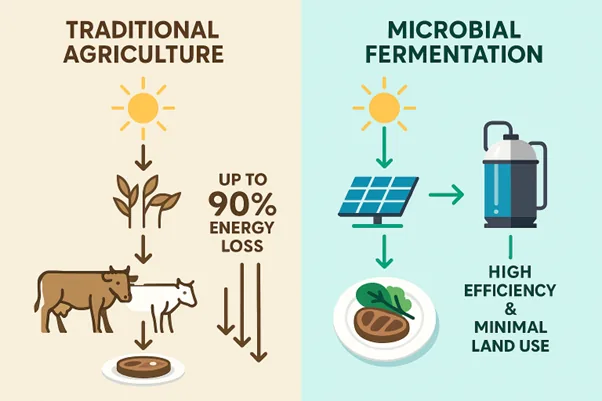
Humanity currently appropriates vast areas of the Earth’s arable land for livestock agriculture, leaving insufficient space for the natural forests and wetlands required to regulate climate and maintain biodiversity. One of the most physically efficient methods of returning land to nature is for humans to systematically move down the food chain.
In the 19th century, Justus von Liebig demonstrated that brewer's yeast could be concentrated into a highly nutritious, edible paste leading to global staples like Marmite and Vegemite. This proved that humans can consume cultivated microorganisms directly, bypassing the immense thermodynamic inefficiency of using plants and animals as biological intermediaries.
By deploying precision fermentation, microbial protein production, and synthetic carbohydrate manufacture, we can produce food directly from microorganisms inside compact bioreactors. Carbon dioxide, methane, and nutrient streams recovered from sewage treatment and industrial processes can be converted directly into feedstocks for high-value proteins and fats. Moving down the food chain dramatically reduces the land footprint of human nutrition, halts topsoil erosion (Montgomery, 2007), and allows tens of millions of hectares of agricultural land to revert to deep carbon sinks.
Easy Fix 4: Fixing the Desalination-Sewage-Cement Nexus
Captured carbon dioxide must be utilised as an industrial resource rather than vented as a waste liability. Current desalination plants dump hypersaline brine back into the ocean, devastating benthic marine life. By integrating desalination with municipal wastewater treatment, we transform this toxic loop into an economic engine.
By using ammonia (NH3) recovered from sewage to regulate the pH of desalination brine, we can bubble captured industrial CO2 through the liquor to precipitate valuable carbonate minerals (Harrison, 2001–2006). This process sequentially drops out:
- Alkaline Calcium Carbonate (CaCO3): Recovered upfront to neutralise global soil acidity and provide low-impact feedstocks for conventional cement.
- Hydrated Magnesium Carbonates: Precipitated as nesquehonite (MgCO3·3H2O) at room temperature, which calcines into reactive magnesia (rMgO) using significantly less thermal energy than raw mined magnesite providing the direct feedstock for Gaia Engineering's carbon-sequestering Eco-Cements.
Under this model, desalination plants evolve from energy-intensive water factories into integrated resource-recovery hubs that manufacture zero-carbon building materials, agricultural fertilisers, and clean irrigation water for dryland restoration.
Phase 2: Structural Integration (Solutions Within the Four Spheres)
The historical Tragedy of the Commons (Hardin, 1968) persists because dumping high-entropy waste molecules into the Atmosphere, Hydrosphere, and Pedosphere has historically carried a zero-dollar price tag, whereas closed-loop recovery requires capital expenditure. To force structural integration, we must align the Anthroposphere across its four primary domains.
1. The Technosphere
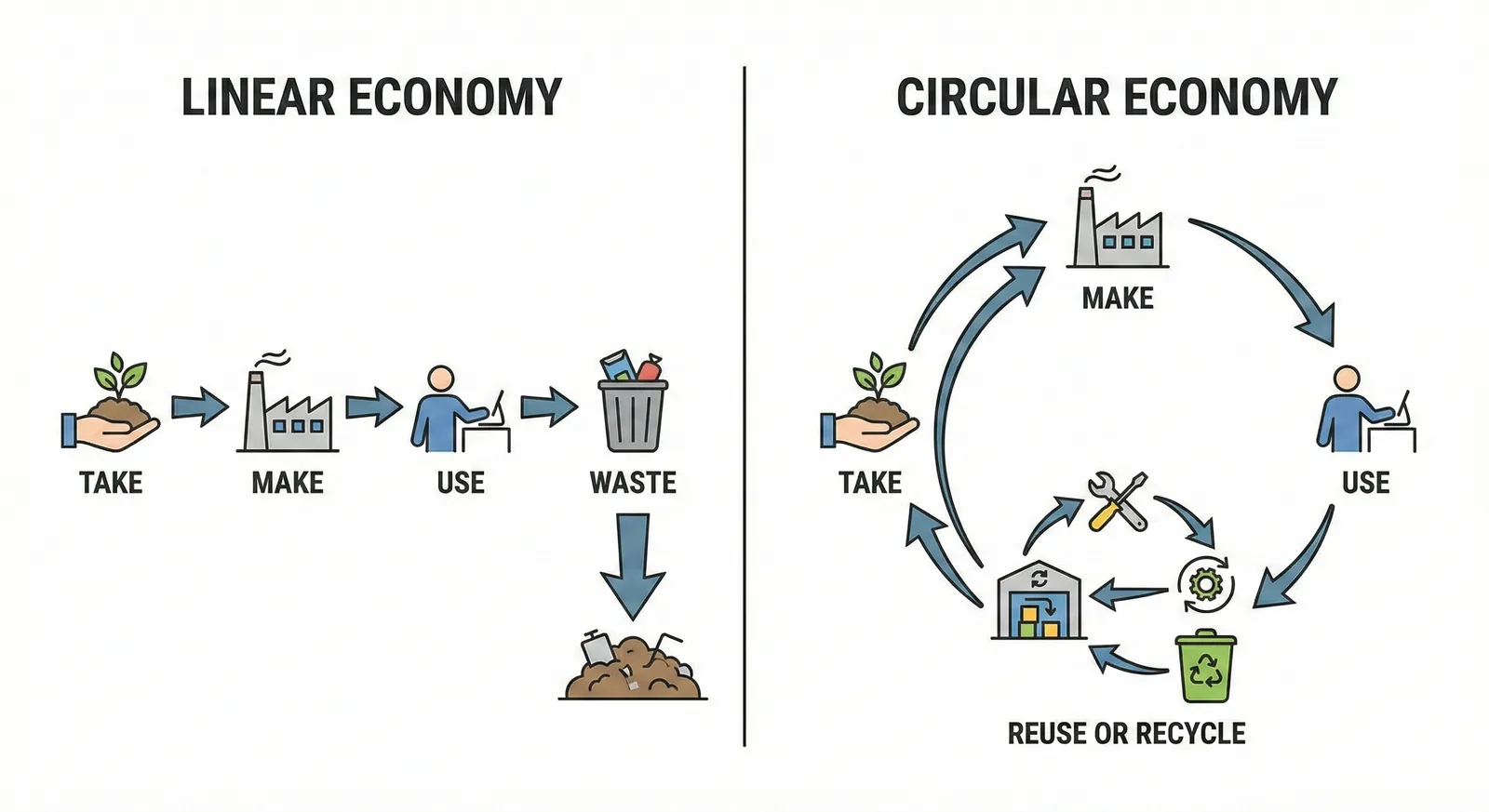
The technosphere represents humanity's direct physical footprint. The linear model is failing. The technosphere must be rebuilt on circular molecular flows:
- Driven Electrochemistry: As renewable solar, wind, and water power drive the marginal cost of daytime electricity down, it will become cheaper to use driven electrochemical potentials (ΔG > 0) to harvest high-purity molecules directly from waste streams than to mine virgin ore.
- Biomimetic Infrastructure (Eco-Cements): Utilising reactive magnesia binders in permeable concrete to permanently lock atmospheric CO2 into the global built environment.
- Right to Repair & Re-manufacture: Mandating modular design and recyclability, heavily penalising planned obsolescence.
2. The Sociosphere
The sociosphere governs societal values, behavioural norms, and our civic definitions of success. Structural failures here include consumption-driven status metrics and profound disconnection from physical ecological limits.
- Moral Internalisation: Cultivating a deep, intrinsic sense of ethical obligation toward planetary stewardship (what Aristotle termed 'Hexis').
- Redefining Prosperity: Shifting the cultural definition of a 'successful life' away from hyper-consumption and material accumulation toward civic contribution, community resilience, and ecological restoration.
3. The Politisphere
The politisphere dictates the formal laws, subsidies, and enforcement structures of human society. It currently fails through massive ongoing subsidies for extractive, high-entropy industries.
- Legal Rights for Nature: Granting formal legal standing to rivers, forests, and keystone ecosystems to protect them from uncosted industrial exploitation.
- Subsidy Realignment: Immediately terminating all state and federal financial subsidies for fossil fuel extraction and destructive, chemical-intensive monoculture agriculture.
4. The Econosphere
The econosphere dictates how financial capital moves. It must be forced to accurately map underlying physical mass-balances.
- Comprehensive Thermodynamic Pricing: Instituting robust Pigouvian taxes (pollution taxes) that price the destruction of physical exergy into the immediate cost of goods (Georgescu-Roegen, 1971).
- Extended Producer Responsibility (EPR): Mandating that manufacturers retain financial and physical liability for the end-of-life recovery of their products.
- Replacing GDP with Physical Reality: Replacing the obsolete, continuous-growth metric of Gross Domestic Product (GDP) with genuine progress metrics (such as GPI) and physical mass-balance indicators such as topsoil depth, ocean pH stability, and ecosystem biomass recovery (Costanza et al., 2014).
Conclusion: Triggering the Tipping Point
The development of advanced intelligence, complex materials technology, and the harnessing of abundant solar energy represents a major evolutionary threshold for the Earth system. By executing the 'easy fixes' proposed and scaling advanced recycling technologies like driven electrochemistry and desalination-brine mineralisation, the Technosphere can cease functioning as a lethal parasite.
Instead, it can evolve into an active, synthetic metabolic co-processor that uses clean energy to maintain the homeostasis of Earth's biogeochemical cycles. Harmony between the Anthroposphere and the Ecosphere is physically possible. Systemic environmental recovery is achievable. Gaia Engineering provides the rigid technical framework for this alignment; it is now entirely up to human governance and market capital to execute it.
References
Almond, R.E.A., Grooten, M. & Petersen, T. (2020). Living Planet Report 2020: Bending the Curve of Biodiversity Loss. Gland, Switzerland: WWF.
Boulding, K.E. (1966). The Economics of the Coming Spaceship Earth. In H. Jarrett (Ed.), Environmental Quality in a Growing Economy. Baltimore: Resources for the Future/Johns Hopkins University Press.
Costanza, R., et al. (2014). Time to leave GDP behind. Nature, 505(7483), pp. 283–285.
Fuller, R.B. (1969). Operating Manual for Spaceship Earth. Carbondale: Southern Illinois University Press.
Georgescu-Roegen, N. (1971). The Entropy Law and the Economic Process. Cambridge, MA: Harvard University Press.
Hardin, G. (1968). The Tragedy of the Commons. Science, 162(3859), pp. 1243–1248.
Harrison, J. (2001–2006). Gaia Engineering and Moleconomics. TecEco Pty. Ltd. Available at: https://www.tececo.com
Montgomery, D.R. (2007). Dirt: The Erosion of Civilizations. Berkeley: University of California Press.
Orr, D.W. (1992). Ecological Literacy: Education and the Transition to a Postmodern World. Albany: State University of New York Press.
Ostrom, E. (1990). Governing the Commons: The Evolution of Institutions for Collective Action. Cambridge University Press.
Ostrom, E. (2010). Polycentric systems for coping with collective action and global environmental change. Global Environmental Change, 20(4), pp. 550–557.